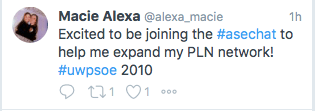
This afternoon I had the opportunity to participate in my very first Twitter Chat. By participating in the online Twitter Chat, I was able to expand my PLN or my Personal Learning Network. For those who do not know, a Personal Learning Network is a web of resources that help you further expand your career and personal knowledge. During this chat, the topic of conversation was common misconceptions in science and how to address them. Even though I am not studying to be a science teacher, I still found a lot of useful tips in the chat, such as how to handle misconceptions in the classroom. There was also advice on how to answer the student’s questions in a way that is not just giving them the answer. The hashtag for this chat was #asechat, and it was lead by Linda Needham. Linda is an education consultant and the immediate past Chair of The ASE. This chat is usually held at least once a week and was created to help inform and give professors and future educators the chance to talk about science related topics.
Overall, I had a pretty decent experience. I am not a science person, but I wanted to give this chat a try and see if I was able to learn anything new. The chat was flowing with a lot of responses and questions, so it was a little hard for me being a first timer to follow along with everything going on. After I got used to the pace of everything though, the content being talked about was a little hard to understand. I did not get a chance to post a lot during the live chat, because for most of the time I was looking up the material the educators and science majors were talking about. However, one comment that stood out to me was written by Marc Neesam. It states, “Evidence, evidence, evidence. Ideally based on first hand experiences which are harder for someone to refute. Someone telling me I have a misconception 100 times is unlikely to shift me unless I see I am wrong.” In this tweet, Neesam is telling the readers that he believes evidence helps children accept scientific explanations contrary to their own. I stumble upon a couple links to websites and books that helped educators learn how to help teach, in a way the students would understand, why these misconceptions about science are wrong. Even though these different ways of showing how the misconceptions are wrong are geared towards science teachers, they can help all teachers. Students typically do not just get confused about science. There are all sorts of different misconceptions in the world that people have a hard time grasping. It is beneficial for educators now and future educators to learn how to deal with these misconceptions and help the students understand the correct information. Not only that, but help them understand why what they are thinking is incorrect.
To help me easily navigate through the chat, I used a website called TweetDeck. TweetDeck was the most helpful tool I used during this experience, because it helped me organize all the feed from the chat. Using Tweetdeck also allowed me to Tweet while staying on the same page as the chat, so I was able to see all the new feed being produced by the other responders.
All in all, the experience was good for my first time participating in a Twitter chat. At the beginning I was very intimidated by all of the intelligence being spewed about between the educators and science professionals. Learning what was being talked about and how to respond was a challenge, but by the end of the chat, I felt a little more comfortable with what was going on. I learned how to handle misconceptions in the classroom, and a couple scientific facts along the way. I would definitely participate in another twitter chat and help grow my Personal Learning Network.


Links to Resources:


 Macie's Educational Media Theory Blog